 The Samsung SPF-83V is a new 8 inch digital photo frame based on Microsoft technology. Photos can be viewed wirelessly from sharing sites such as Windows Live Spaces or from your PC. The Samsung SPF-83V frame also communicates with Windows Media Player and open standards such as RSS. “Our latest digital photo frames, based on cutting-edge technology from the Microsoft Research labs, are easy to use and are one of the few offerings in the marketplace that offer a ‘network’ approach to digital photo sharing.” said Christopher Franey, vice president of Commercial Sales and Marketing at Samsung Electronics America. Price and availability of the Samsung SPF-83V to be announced.
Samsung Press Release
Samsung Licenses Microsoft Technology for Wireless Digital Photo Frame
New consumer product, available in time for the holidays, is one of the few networked offerings on the market and is result of ongoing licensing and technology collaboration between the two companies.
REDMOND, Wash. and IRVINE, Calif., Dec. 12 /PRNewswire-FirstCall/—Samsung Electronics America Inc., a subsidiary of Samsung Electronics Corporation, today announced the release of its new 8” Digital Photo Frame SPF-83V, based on technology developed by Microsoft Research, in time for the holiday season. With this innovative addition to their photo frame lineup, customers can enjoy photos wirelessly in their home and display photos from sharing sites such as Windows Live Spaces or from personal collections on their PC.
The frame works with the Windows Live Photo Gallery, which makes sharing photos with friends and family easy. Users can organize and upload individual photos or albums from their PC to Windows Live Spaces and the photos are ready for display on the frame.
Along with the technology licensed from Microsoft Research, the Samsung frame communicates with Windows Media Player and open standards such as RSS. The product is a result of a long-standing collaboration between Microsoft Corp. and Samsung Electronics, including a patent cross-licensing agreement signed by the two companies in April 2007.
“Offering our customers next-generation products that bring them closer to family and friends is important to us,” said Christopher Franey, vice president of Commercial Sales and Marketing at Samsung Electronics America, Information Technology Division. “Our latest digital photo frames, based on cutting-edge technology from the Microsoft Research labs, are easy to use and are one of the few offerings in the marketplace that offer a ‘network’ approach to digital photo sharing. This is a great example of our ongoing collaboration with Microsoft, and we are confident that the resulting product will be received extremely well.”
“Working with industry leaders such as Samsung to allow them to deploy Microsoft’s innovative technologies and bring great products and services to customers more rapidly is what our intellectual property licensing efforts are all about,” said Louis Carbonneau, general manager of Intellectual Property Licensing at Microsoft. “This is just one example of how our dedication to open innovation can lead to greater collaboration between two technology industry leaders and to great products—right in time for the holidays.”
More information about the full offering of Samsung digital photo frames can be found at http://www.samsung.com/.
About Samsung Electronics America Information Technology Division
Samsung’s Information Technology Division (ITD) markets a complete line of award-winning LCD Monitor products, including professional large format LCD and Plasma displays. ITD also markets an award-winning line of color and monochrome laser printers and multifunction devices, video security systems and the family of Samsung Q1 Ultra-Mobile Personal Computers (UMPC). Samsung ITD is committed to supporting the needs of its channel partners in the professional, commercial, corporate, and SOHO markets. Based in Irvine, California, ITD is a division of Samsung Electronics America (SEA), a U.S. subsidiary of Samsung Electronics Company, Ltd. (SEC). The SEA organization oversees the North American operations of Samsung including Samsung Telecommunications America, LP, Samsung Electronics Canada, Inc. and Samsung Electronics Mexico, Inc. Please visit http://www.samsung.com/ for more information or call 1-800-SAMSUNG for more information.
About Samsung
Samsung Electronics Co., Ltd. is a global leader in semiconductor, telecommunication, digital media and digital convergence technologies with 2006 parent company sales of US$63.4 billion and net income of US$8.5 billion. Employing approximately 138,000 people in 124 offices in 56 countries, the company consists of five main business units: Digital Media Business, LCD Business, Semiconductor Business, Telecommunication Network Business, and Digital Appliance Business. Recognized as one of the fastest growing global brands, Samsung Electronics is a leading producer of digital TVs, memory chips, mobile phones and TFT-LCDs. For more information, please visit http://www.samsung.com/.
About Microsoft
Founded in 1975, Microsoft (NASDAQ:MSFT) is the worldwide leader in software, services and solutions that help people and businesses realize their full potential.
Source
Thursday, December 13, 2007
Samsung reveals wireless 8-inch SPF-83V digiframe

Monday, December 3, 2007
Samsung announces world's fastest memory: GDDR5
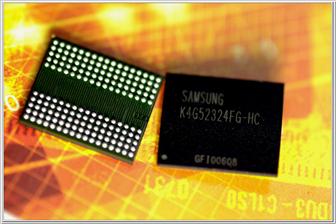
Samsung Electronics has announced that it has developed the world's fastest memory, a GDDR5 (series five, graphics double-data-rate memory) chip that can transfer data at six gigabits per second (Gbps).
Samsung's GDDR5, which will be introduced at a density of 512 Mb (16Mb x 32) chips, is capable of transmitting moving images and associated data at 24 gigabytes per second (GBps).
The new Samsung graphics memory operates at 1.5 volts, representing an approximate 20% improvement in power consumption over today's most popular graphics chip, the GDDR3.
Samples of Samsung's new GDDR5 chip have been delivered to major graphic processor companies last month and mass production is expected in the first half of 2007.
Samsung expects that GDDR5 memory chips will become the de facto standard in the top performing segment of the market by capturing more than 50% of the high-end PC graphics market by 2010.
Saturday, November 17, 2007
Samsung's New Combo HD Player: Way Too Pricey
 Samsung has been teasing us for months about its upcoming dual-format HD player; first, there were only rumors, then word came in April that the Blu-ray/HD DVD player was, indeed, actually coming, but Samsung didn't reveal much beyond that. Today, however, we're getting the main specs, some pictures, a release date (before year's end) and a price: $1,049. Ouch. The first pictures of the BD-UP5000 are pretty much what you'd expect—a big black box with a your standard digital readout and some blue glowing buttons. Under the hood, however, is the good stuff, including full compatibility with the HDi- and BD-Java-powered interactive extras on both Blu-ray and HD DVD discs, neatly fixing a problem that plagued LG's spotty combo HD player, the BH100. You'll also get full 1080p output for Blu-ray and HD DVD (including 24 frame-per-second playback on Blu-ray discs, making for smoother, more film-like picture), the latest in high-def audio formats (Dolby TrueHD and DTS-HD), and an HDMI 1.3 port (which can send both video and Dolby TrueHD/DTS-HD sound to your receiver). The BD-UP5000 could be a silver bullet for your Blu-ray/HD DVD compatibility woes if money's no object; for the rest of us, however, the $1,049 price tag is simply too high. Why? Because for a total of $800, you can pick up a 60GB PlayStation 3 with a built-in Blu-ray drive ($500) and a cheap Toshiba HD DVD player ($300). Yes, that's two boxes compared to a single BD-UP5000 player, but you'll be getting a next-gen gaming console in the bargain. A Samsung rep admitted to me that the company may lower the BD-UP5000's sky-high price tag depending on market prices in the next few months; let's hope Samsung follows through on that.
Friday, November 16, 2007
Samsung ML-1630 Laser Printer- The sexy printer

Don't want a big, ugly, boxy laser printer on your desk? The $199.95 Samsung ML-1630 lets you add monochrome laser printing to your work area with style. This low-profile device looks more like a cross between a scanner and the monolith from 2001: A Space Odyssey than a typical printer. Best of all, the designers didn't put all their efforts into its appearance: The ML-1630 offers excellent print quality, fast startup, and reasonably good print speeds.
Setup is a snap. Attach the power cord, connect a USB 2.0 cable (not included), and drop in the toner cartridge. The toughest part is trying to remove the annoying sticker affixed to the top of the otherwise-stylish, shiny piano-black plastic casing.
The ML-1630 takes up about as much desktop space as a typical laser printer, at 13 inches wide by 14.7 inches deep, but it's only 4.8 inches tall. Powering on the printer reveals a slick blue LED readout that shows the current page count and any error info. The body sports just two touch-sensitive controls: power and cancel.
Print quality is above-average for a consumer laser printer. Text at both 600 dots per inch (dpi) and 1,200dpi is crisp and readable, even at small font sizes and in gray-scale output. Graphics look very good, and although dithering is evident in photos (which is typical of most monochrome lasers), we noted almost no banding in any of our image tests.
True to Samsung's rated engine speed, printing was consistent at 17 pages per minute, whether we were printing plain text or elaborate full-page graphics. Unlike some printers that take 20 seconds or more to warm up before they begin printing, the ML-1630 spits out its first page within 8 seconds. Though it's not truly “silent” as claimed, it's noticeably quieter than other personal lasers we've tested.
The ML-1630 ships with a 1,000-page starter cartridge. Replacement cartridges cost $69.95 and are rated to last 2,000 pages, which works out to an affordable 3.5 cents per page. The paper tray holds just 100 sheets, so you'll need to reload paper fairly frequently. The tray will accommodate paper as small as 4.1x5.8 inches and as large as A4, but the ML-1630 doesn't support printing on envelopes.
Given the printer's emphasis on design and style, it's no wonder that Apple and Samsung worked out a deal to offer the ML-1630 exclusively in Apple stores through the end of December. Many of Apple's hardware devices share another quality with the printer: The ML-1630 also costs more than similar devices in its performance class. For the same price, you can find monochrome lasers that offer faster printing, larger paper capacity, or networking ports. But none of those will look half as good on your desktop.

