
Showing posts with label USB. Show all posts
Showing posts with label USB. Show all posts
Wednesday, January 2, 2008
SanDisk's Cruzer Titanium Plus flash drive


Tuesday, January 1, 2008
Lenovo rolls out Olympic-themed USB drive


Its innovative technology and symbol of China's impression of the Millennium "lacquer red" color and "Xiangyun" pictorial beauty, the 2008
Olympic Games are approaching footsteps, we are prepared to use the telephone to see what size event live?
Of course, this is not practical products, but in 2008 the time should have been given for foreign friends as souvenirs.
Source
Thursday, December 20, 2007
Gemei Readies Fancy US Series Media Player
Gemei’s United States X590 is inspired by the most powerful country, boasting a design that is simply, well, Chinese. The X590 boasts a 2.5-inch screen that supports 16 million colors. On each side of the screen is a rather roomy setup of buttons that makes it obvious this PMP is meant for gaming. Hopefully you’re into MD / SFC / NEO games. If movie watching is your thing, you have an array of file formats playable on the X590: RM, RMVB, FLV, AVI, DAT. For audio, MP3, WMA, APE and FLAC are supported. No word on price yet but we know it comes in lilac.
Source

Thursday, December 13, 2007
SHD-U32GS, a new 32GB TurboUSB memory Card
 If you are desperately looking for a way to download all your company's client database before running away with it and selling it to any competitors, here you are, maybe the ultimate USB Key, which will allow you to store up to 32GB of data and which will be 20% faster than any other USB Key thanks to the Buffalo’s TurboUSB…
Oh by the way, I am not responsible if someone will actually do what I just wrote previously…
Source
Monday, November 19, 2007
USB 3.0 -- 10 Times Faster -- In the Works for 2009

USB, that little rectangular plug that can be found on just about every computer peripheral cable you come across, is one of the biggest success stories in the history of computing. Ditching the slow serial and parallel cables of yore and replacing them with a fast, universal standard that could draw power and allowed connecting of dozens of peripherals without rebooting... well, it was genius. When USB 2.0 arrived, with much faster performance, it got even better. It's not hyperbole to say that USB, despite its humble status as a mere connector, is one of the most important computer technologies to ever
be invented.
Well, USB fans, things are going to get even more interesting and soon. USB 2.0 may be fast enough right now, but with
more high-definition video products arriving and bigger and bigger files being transferred, that won't be the case forever. Enter USB 3.0, which moves the bandwidth needle from 480Mbps to roughly 4.8Gbps, 10 times faster than the current version.
The new standard, which was recently demonstrated using a new optical cable (but the same connector), will be backward compatible with older USB formats and promises better power efficiency, too, in order to decrease the load on portable devices. Possibly in the works: Better ability to charge devices over USB, some of which still require an A/C adapter or
two USB connections to draw enough juice.
Specs are planned to be delivered early next year with commercial availability for 2009. Just do us a favor and clearly label USB 3.0 products with an appropriate logo this time! (USB 2.0 got caught up in a mini scandal when vendors started labeling USB 1.1 products as "USB 2.0 capable," with vendors later claiming they only meant the products worked with USB 2.0
connections. Fail!)
Friday, November 16, 2007
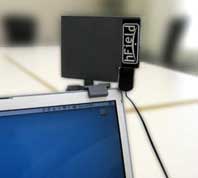
Wi-Fire Range Extender
Source
Subscribe to:
Comment Feed (RSS)

